

Every brand changes with time, but not every change calls for a rebrand.
Maybe your audience has shifted. Your visual identity feels dated. Your messaging no longer reflects the quality of your work. When that happens, the instinct may be to start over, redesign everything, rewrite every message, and introduce a completely new version of the business.
But a rebrand is not a magic fix. In many cases, the strongest move is not to replace the brand you have, but to evolve it with greater clarity and intention.
The question is not simply whether your brand needs to change. It is how much change it actually needs.
Here is how to tell the difference between a full rebrand and a thoughtful brand refresh, and how to approach either one with strategy rather than impulse.
Although the terms are often used interchangeably, a rebrand and a brand refresh solve different kinds of problems.
A brand refresh updates how an existing brand looks, sounds, or shows up. It builds on the foundation already in place while refining elements that feel outdated, inconsistent, or unclear.
A refresh might include:
The core identity of the business remains recognizable. The goal is to make the brand feel more current, cohesive, and aligned with where the company is today.
A rebrand, on the other hand, involves a deeper transformation. It may redefine the brand’s positioning, purpose, personality, audience, name, messaging, or complete visual identity.
A rebrand asks foundational questions: Who are we? Who are we for? What do we stand for? How should people understand us now?
The difference is not simply the number of design elements being changed. It is the level of strategic change happening underneath them.
A refresh changes the expression of the brand. A rebrand may change the meaning of the brand itself.
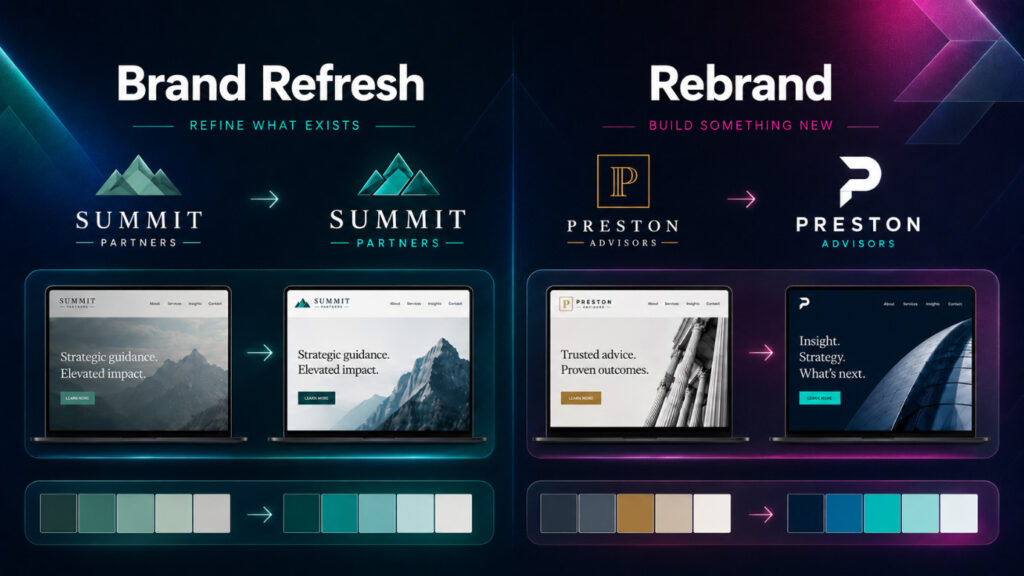
A full rebrand can be valuable when the current identity no longer supports the direction of the business. It should be driven by a meaningful strategic shift, not simply boredom with a logo.
Here are some of the clearest signs that a deeper reset may be necessary.
Many businesses outgrow the identities they started with.
Perhaps you launched with one service and now offer several. Maybe you began as a local business and are expanding into new markets. Your pricing, positioning, team, or long-term vision may look very different from what they did when the brand was created.
When the business model has changed significantly, the existing brand may create more confusion than recognition.
A full rebrand can help close the gap between the company you were and the company you have become.
Brands are built around relationships. When the audience changes, the brand may need to change with it.
A visual identity and message designed for one customer group may not resonate with another. This is especially important when moving into a new market, shifting from consumer to business clients, targeting a more premium audience, or expanding beyond a niche.
The goal is not to chase every new demographic. It is to make sure the brand speaks clearly to the people the business is now best positioned to serve.
A brand can look polished and still be strategically weak.
When potential customers do not understand what makes the business different, a cosmetic update will not solve the real problem. The same is true when the market has changed and the brand’s original positioning no longer feels distinctive.
In this situation, the work needs to begin beneath the surface. The business may need to reconsider its value proposition, competitive position, core message, or brand promise before moving into design.
Sometimes a brand becomes connected to a perception the business has outgrown, or one it never intended to create.
Customers may see the company as inexpensive when it wants to be known for quality. They may view it as traditional when it has become more innovative. The brand may also carry reputational baggage from an earlier chapter of the business.
A rebrand cannot erase a genuine operational problem. But when the business itself has changed, a new identity can help signal that change and create space for a different relationship with the market.
Your current brand cannot support future growth
A small business branding system may work well at launch but struggle as the company grows.
Perhaps the identity does not translate across digital platforms, packaging, signage, social media, or new service lines. Maybe the business name is too narrow. The visual system may rely on one logo without the flexibility needed for a larger organization.
A strategic rebrand can create a more scalable foundation, one designed not only for how the business operates today, but for where it intends to go next.
Not every mismatch between the brand and the business requires a complete reset. Often, the foundation is still strong. It simply needs to be expressed more effectively.
Brand evolution may be the better path when recognition, trust, and equity already exist.
Design changes. A visual identity created several years ago may begin to feel behind the times even when the business itself remains relevant.
In that case, the answer may be to refine rather than replace.
Updating typography, simplifying a logo, adjusting the colour palette, improving photography, or creating a more flexible layout system can make a brand feel current without sacrificing familiarity.
This approach preserves what customers already recognize while improving how the business presents itself.
Your messaging needs more clarity
Sometimes the brand does not need a new story. It needs a clearer way of telling the existing one.
As businesses grow, messaging often becomes crowded. New services are added, different team members describe the company in different ways, and the website accumulates language that no longer serves a clear purpose.
A brand refresh can help organize the message around a stronger value proposition, a more consistent voice, and a simpler explanation of what the business does.
Before assuming the brand is broken, look at how it is being used.
A strong identity can appear weak when it is applied inconsistently. Different colours, conflicting typefaces, unclear templates, mismatched photography, and an uneven tone of voice can make a business feel less established than it is.
In this situation, the solution may be a better business branding system rather than a new brand. Clear guidelines, practical templates, and a more flexible set of visual tools may be enough to create cohesion.
Growth does not always require reinvention.
A business may be reaching more people while continuing to serve the same fundamental needs. The audience may be broader, more sophisticated, or more diverse, but still connected to the original brand promise.
Thoughtful brand evolution can help the business mature alongside its customers without abandoning the qualities that built trust in the first place.
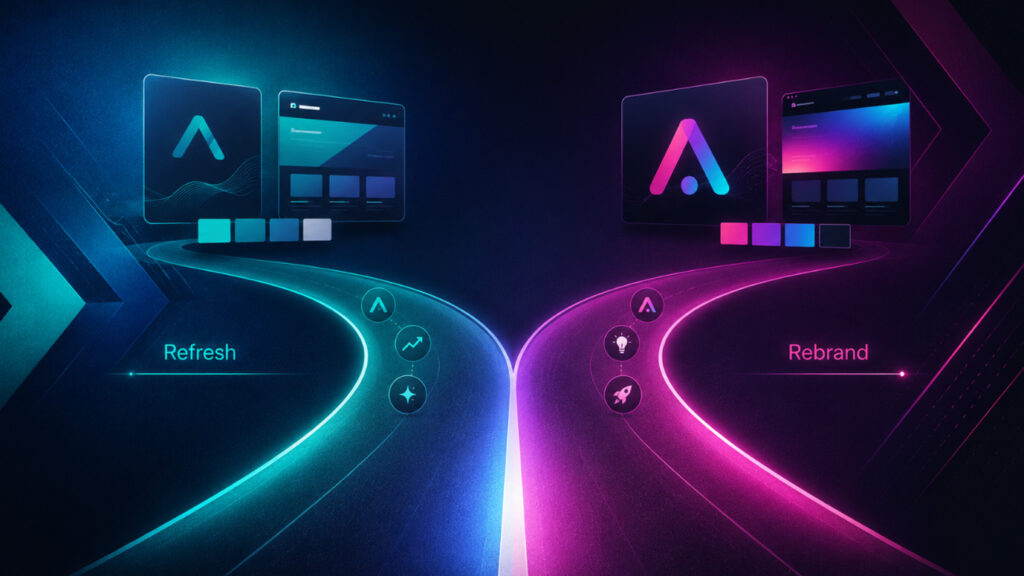
The smartest way to decide when to rebrand is to separate symptoms from causes.
A dated website is a symptom. Confusing positioning is a cause.
Inconsistent visuals are a symptom. The absence of a usable brand system is a cause.
Declining engagement is a symptom. A mismatch between the business and its audience may be the cause, but so could a weak offer, poor customer experience, or changing market conditions.
Before changing the brand, ask:
What has changed in the business?
Look at the services, audience, pricing, market, team, values, and long-term goals.
What is no longer working?
Identify specific points of friction rather than relying on a general feeling that the brand is “off.”
What still has value?
Consider the elements customers recognize, trust, or feel emotionally connected to.
What does the new direction need to accomplish?
Define what success would look like. Better recognition? A more premium perception? Greater clarity? A system that supports expansion?
These questions help determine the scope of the work.
When the foundation is still relevant, evolve it. When the foundation no longer reflects the business, rebuild it.
Approach the Process Strategically
Whether you choose a full rebrand or a brand refresh, design should not be the first step.
Start with discovery.
Review the current brand, customer feedback, business goals, market position, and competitive landscape. Speak with the people closest to the business, including employees, leadership, customers, and partners. Look for patterns in how the brand is understood internally and externally.
From there, establish the strategy that will guide the creative work.
This may include defining:
Only then should decisions about logos, colours, typography, imagery, and language begin.
This order matters. Without a clear design strategy, a rebrand can become a collection of subjective preferences. With strategy, every creative decision has a purpose.
Change can generate attention, but attention is not the same as connection.
When a business changes every recognizable element at once, customers may struggle to understand what happened. A dramatic shift can weaken familiarity, create uncertainty, or make a trusted company feel like an entirely different organization.
This does not mean brands should avoid bold decisions. It means those decisions should be proportionate to the problem.
One of the most common rebranding mistakes is assuming that “new” automatically means “better.” A completely different visual identity may feel exciting internally while creating unnecessary distance from the audience.
There is also a risk of using rebranding to avoid more difficult business questions. New design cannot fix an unclear offer, inconsistent service, weak leadership, or poor customer experience. The identity can support business change, but it cannot substitute for it.
Before removing a recognizable asset, understand what role it plays. Before introducing a new message, make sure the business can deliver on it. Before announcing transformation, ensure the change is real.
The most effective brand evolution balances familiarity with progress.
Continuity does not require keeping everything. It requires identifying the parts of the brand that hold meaning and carrying them forward with intention.
That might mean preserving a recognizable colour while modernizing the wider palette. It could involve simplifying the logo rather than replacing it, retaining part of the name, or building new messaging around a long-standing brand promise.
Continuity can also come from the customer experience. Even when the visual identity changes significantly, familiar values, service standards, and communication habits can reassure customers that the heart of the business remains intact.
A thoughtful rollout is equally important.
Explain why the brand is changing and what the change represents. Give employees the tools to communicate it consistently. Update major customer touchpoints in a coordinated way. Make the transition easy to understand rather than expecting the audience to interpret it on their own.
The goal is not to preserve the past at all costs. It is to make the next version of the brand feel credible, like a natural step forward rather than an unexpected departure.
A successful rebrand is not measured by how different the business looks.
It is measured by how accurately the brand reflects the business, how clearly it communicates value, and how effectively it supports future growth.
Sometimes that requires a complete reset. More often, it requires a thoughtful evolution: clearer messaging, stronger design systems, and a more intentional expression of what already makes the business valuable.
Before starting over, take the time to understand what needs to change and what deserves to remain.
The strongest brands are not static, but they are not constantly reinventing themselves either. They evolve with purpose.
Whether you are evolving an existing identity or starting fresh, Weaver helps businesses reshape their brands with purpose and clarity.